
Choosing a UPS system is no small feat. With so many different brands, models, and configurations available, it’s difficult to know which option fits your needs. And the right choice isn’t simply about picking the system that fits your data room or the one with the most advanced features.
If you’re considering a Toshiba UPS, you’ll also need to decide between modular and monolithic architecture. Though both keep the lights on and protect critical loads, they’re designed to support different configurations, capacities, and growth requirements.
What Are Monolithic Systems?
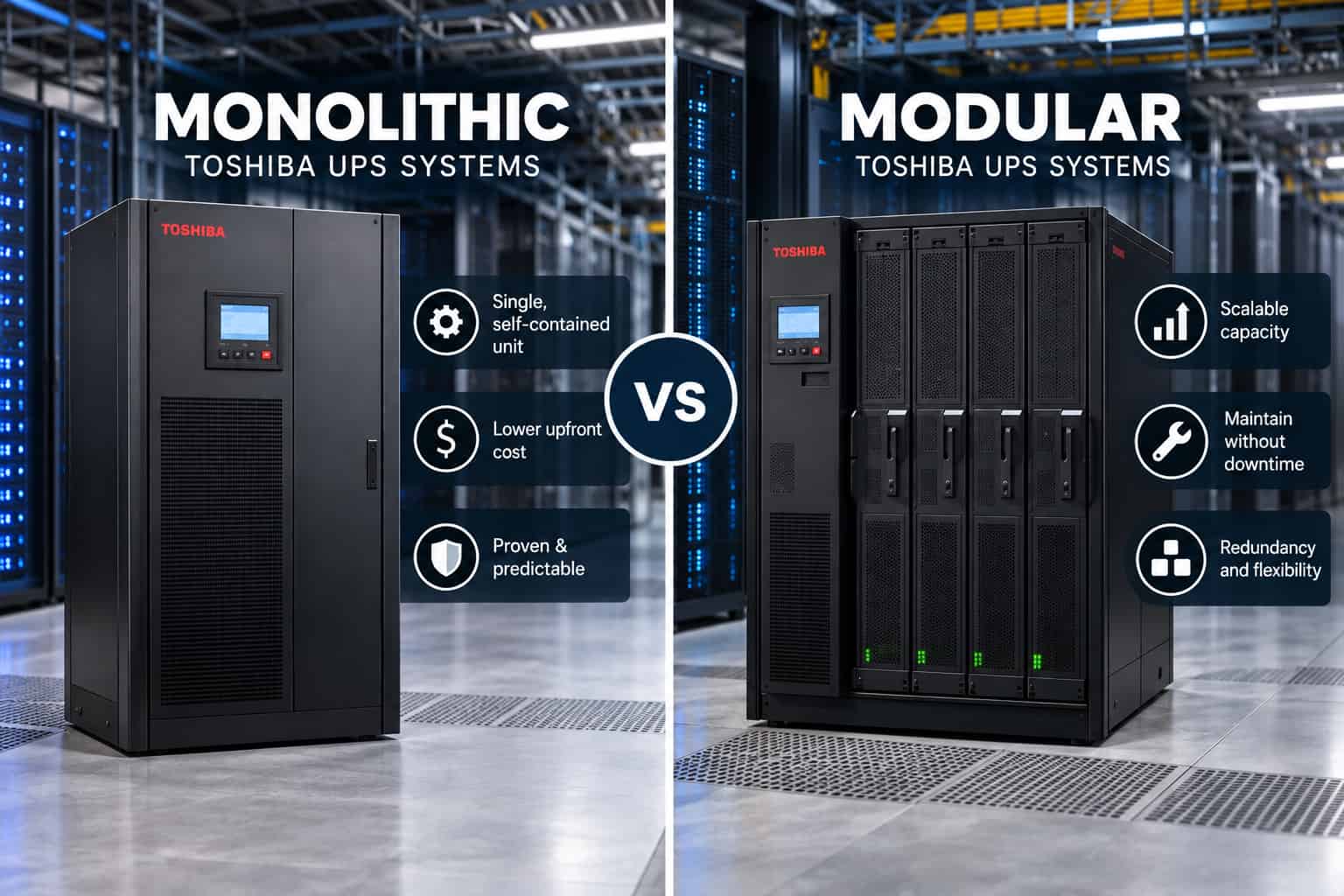
A monolithic UPS is a single, self-contained unit built to handle an entire load on its own. Instead of dividing the system’s capacity across several power modules, it houses its power conversion component in one large unit.
These systems have been the standard for a long time, and for good reason:
- Simple to install with fewer components to coordinate
- Lower upfront cost in many cases
- Fewer parts means fewer potential points of failure in a basic sense
The tradeoff is flexibility. If the load grows past what the unit can handle, there’s no way to add capacity. At that point, the entire system will need replacing.
What Are Modular Systems?
Modular UPS systems work differently. Instead of one large unit, power comes from several smaller modules working in parallel inside a shared frame. That way, capacity is distributed across these individual modules that can be added or replaced as power requirements change.
This setup affects a few key considerations:
- Capacity can be added by sliding in another module, with no full replacement needed
- If one module fails, the others keep the load running
- Maintenance can happen on one module while the rest of the system stays online
For facilities that expect to grow, like data centers adding server racks or hospitals bringing new equipment online, that flexibility can be a major advantage.
Reliability Is Not as Simple as “More Modules, More Safety”
It’s easy to assume modular automatically equates to more reliable. While modular can offer redundancy, it doesn’t always make a system more reliable.
Modular systems reduce the risk of a single point of failure since the load is split across units. But they also introduce more connection points and components that need to be maintained correctly. More importantly, a system with multiple modules isn’t necessarily redundant if every module is required to handle the full load. A poorly maintained modular system can underperform a well-maintained monolithic one.
Monolithic systems, on the other hand, are proven and predictable. Fewer moving parts can mean fewer things that need maintaining and troubleshooting down the line. For facilities with a smaller footprint or a stable, unchanging load, a monolithic system can offer reliable power protection without the complexity of a modular design.
The real answer depends on the site, not the architecture alone.
Which UPS Architecture Makes Sense For Your Facility?
When you’re making a decision, consider your facility’s current needs and future plans.
- Choose monolithic when the load is stable and unlikely to grow, budget is a priority upfront, or the facility is smaller with straightforward power needs.
- Choose modular when future growth is expected, uptime requirements are strict, or equipment needs to be serviced without interrupting power.
Healthcare facilities and data centers tend to lean modular because downtime can have serious consequences and growth is almost guaranteed as equipment and infrastructure are added. Smaller commercial or residential projects often do fine with a monolithic setup because of their more predictable power needs and less need for future expansion. In these cases, a monolithic UPS can provide the right protection more simply, especially when budget is a priority.
Pairing the Right UPS With the Right Infrastructure
Whichever architecture you choose, the UPS doesn’t work in isolation. It needs to coordinate with switchgear, transfer equipment, and power quality tools to keep a facility distributing clean, reliable power throughout the facility.
CORE Support Systems pairs Toshiba UPS systems, modular and monolithic, with complementary power infrastructure from manufacturers such as Trystar, 360 Power Quality, and PQ Protection. Bringing these components into the planning process can help prevent compatibility issues once installation starts.
There’s no universal right answer between modular and monolithic. What matters is matching the architecture to the site’s real needs, not just what looks impressive on paper.
At CORE Support Systems, we help contractors and engineers across Oregon and California figure out which configuration actually fits their project. Visit CORE Support Systems to discuss your power requirements and installation.